

Updated: Aug 28
Short answer: The Mara River crossings are the most concentrated act of drama in the natural world — hundreds of thousands of wildebeest gambling their lives at a single muddy bank, watched by five-metre crocodiles that have learned the calendar better than any guide. They happen along the northern Serengeti between roughly late July and mid-October, with September the statistical high point. But the herds keep no diary: they cross when thirst, grass and nerve finally tip the balance, and not a day before.
Why the herds have to cross at all
The Great Migration is not a stampede but a slow, rainfall-driven loop — roughly 1,000 kilometres a year through the greater Serengeti–Mara ecosystem. It carries some 1.5 million wildebeest, 250,000 zebra and 400,000–500,000 Thomson's gazelle, close to two million grazing animals moving as one restless organism in search of the greenest grass.
By the dry heart of the year the southern short-grass plains have turned to dust, and the only dependable water and forage lies to the north — across the Mara River. The river is the toll booth on the way to survival, and the herds pay in blood. Along the whole route, an estimated 250,000 wildebeest die each year: about one animal in six.
When the crossings happen (and why the date is the wrong thing to fix on)
Rainfall shifts the timetable by weeks from one year to the next. In a wet year the herds dawdle and arrive late; in a dry one they may cross, graze, and recross the same river three or four times in a season. Treat the window below as a probability, never a promise.
Window | What's happening on the river | Chance of seeing a crossing |
Late Jun – mid Jul | Vanguard herds reach the Grumeti in the western corridor, not yet the Mara | Low on the Mara |
Mid Jul – early Aug | First columns mass at Kogatende; tentative early crossings | Moderate |
Mid Aug – late Sep | Peak build-up on the northern bank; large, chaotic crossings | Highest |
Early Oct – mid Oct | Return crossings south as the short rains stir over the plains | Moderate to high |
Late Oct – Nov | Herds thin and drift back toward the central Serengeti | Low, unpredictable |
Anatomy of a crossing
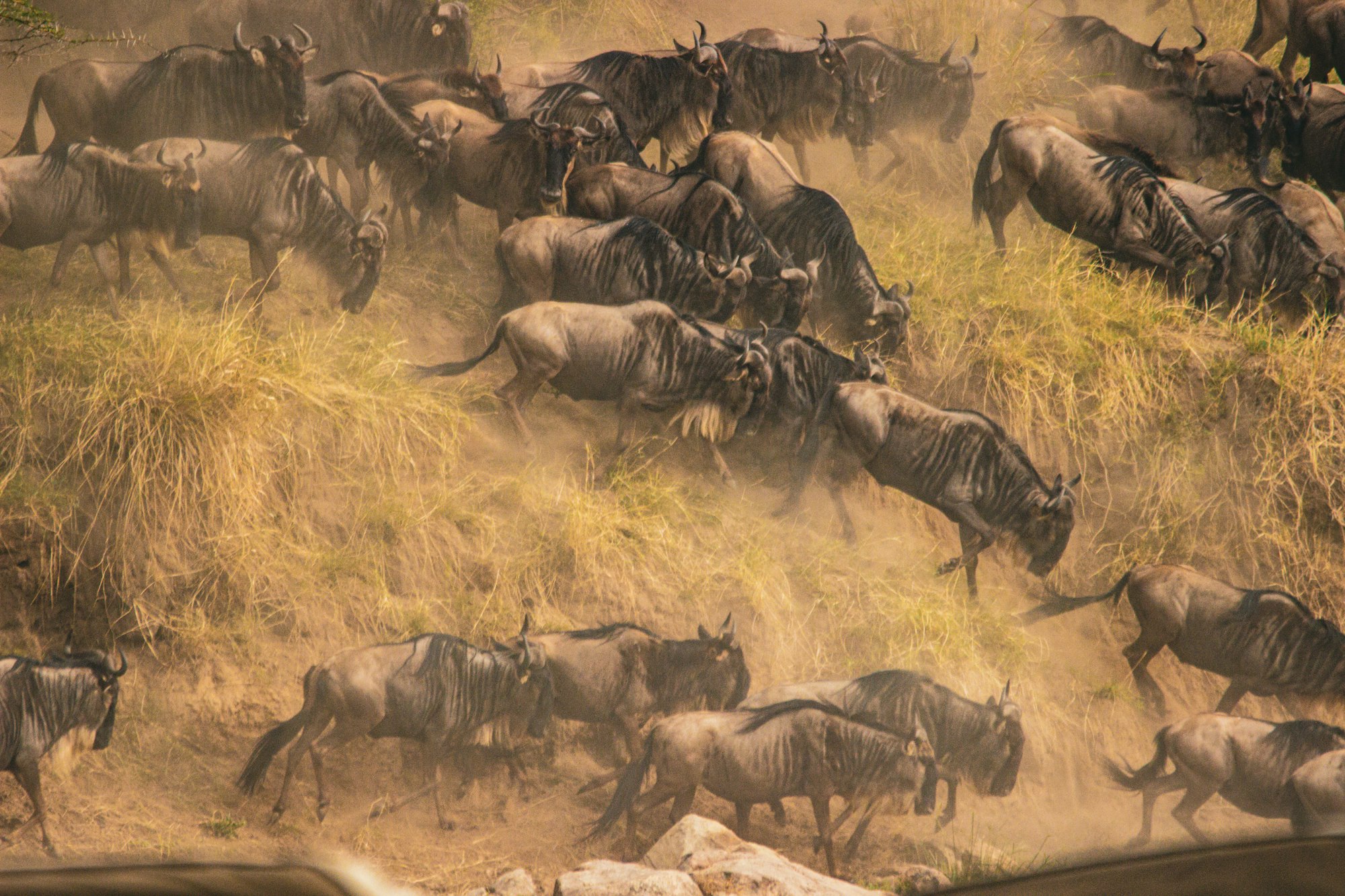
A crossing is mostly waiting. A herd may pile up on the bank for six hours, ten thousand animals deep, grunting and shuffling while the front rank loses its nerve and turns back into the crowd. Then a single wildebeest — or a bolder zebra, whose sharper eyesight the wildebeest seem to trust — plunges in, and the dam breaks. What follows is not graceful. Animals leap blind from three- to six-metre banks, land on the backs of those ahead, and swim a current that funnels them toward the waiting jaws. More die from broken legs, drowning and sheer trampling than from predators. Minutes later it can stop as abruptly as it began, the survivors grazing calmly on the far side as if nothing had happened.
The crocodiles — and the surprising truth about who eats the dead
The Mara's giant Nile crocodiles are the villains of every wildlife film: some over five metres long and older than forty, individuals that lie in ambush at the same crossing points year after year. Yet they are a small part of the real story. A landmark 2017 study in the journal PNAS, led by ecologist Amanda Subalusky, found that an average of 6,200 wildebeest drown in the Mara each year — around 1,100 tonnes of flesh and bone, delivered in mass drownings that struck in 13 of the 15 years studied. The researchers likened it to dropping the equivalent of ten blue whale carcasses into a modest river, every single year.
Crocodiles consume only about 2% of that windfall. Vultures and marabou storks take a further 6–9% of the soft tissue; the rest feeds the river itself. Drowned wildebeest make up between 34% and 50% of the diet of common Mara fish while carcasses are present, and the bones linger for seven years or more, their slow-growing biofilm becoming a lasting source of phosphorus and a food in its own right. The crossing, in other words, is not only a spectacle. It is one of the largest annual pulses of nutrients from land to water anywhere on Earth — the migration feeding the river that nearly kills it.
Where to base yourself
Serious crossing-watchers stay inside the northern Serengeti rather than commuting from central Seronera, which is simply too far south in peak season. The two prime sectors:
Kogatende: the heartland, with a dozen well-known crossing points within a morning's drive, reached by a 90-minute charter flight from Arusha rather than a punishing full-day transfer.
Lamai Wedge: tucked between the river and the Kenyan border — quieter, and with a better chance of having a sighting to yourself.
What a crossing-season safari costs in 2026
The northern Serengeti is at its most expensive in the exact weeks the crossings peak, and park fees are charged on top of most quoted rates. Current non-resident charges break down like this:
Charge (non-resident adult) | Rate |
Serengeti park entry | $83 per 24 hours |
In-park concession (if staying at a lodge/camp) | $60 per 24 hours |
VAT on the above | 18% |
Typical all-in park cost at a lodge | ≈ $169 per day |
Add guiding, vehicle, camp and transfers, and a realistic daily budget looks like this:
Tier | Per person, per day | What it buys |
Mid-range mobile camp | $650–900 | Shared vehicle, tented camp within reach of the river |
Premium tented camp | $1,000–1,600 | Private guide, prime Kogatende location, fly-in access |
Ultra-luxury | $1,800–3,500+ | Exclusive-use camps, helicopter transfers, a dawn balloon flight (~$599) |
Photographing the crossing well — and kindly
Two rules matter more than any camera setting. First, patience: read the animals, not the clock, and let your guide watch the giraffes downriver and the ears of the lead zebra for the tell. Second, restraint: vehicles that crowd the water's edge can turn a nervous herd back and cost everyone — animals included — the moment. Leave the front row to the wildebeest. A 400mm lens from thirty metres back, a shutter of 1/1600s or faster to freeze the leap, and continuous autofocus will tell the story far better than a phone held over the bank. Check out the photography program of The Singing Grass.
The Serengeti gives up its greatest spectacle only to those willing to wait for it. Plan for the window, not the day — and let the river decide.
Related reading
When Is the Best Time to See the Great Migration? — a 2026 month-by-month guide
Calving Season in the Serengeti — 500,000 wildebeest born in a few weeks
Where to Stay in the Serengeti — best areas and camps for every season


Comments